Augmented & Rare Modular Gear
Augmented and Rare weapons use a shared modular parts system across all five Earth corporations. Armor uses three shared families only (Light / Medium / Heavy) with no modular parts — armor power comes from Prefix / Suffix rolls (including former module roles such as Plating, Underlayer, Sealant, Power Cell, Sensor Pack, Servo Bundle, and Trauma Weave). Legendary / Unique / Apex items are a separate hand-authored tier and are not built from modular kits.
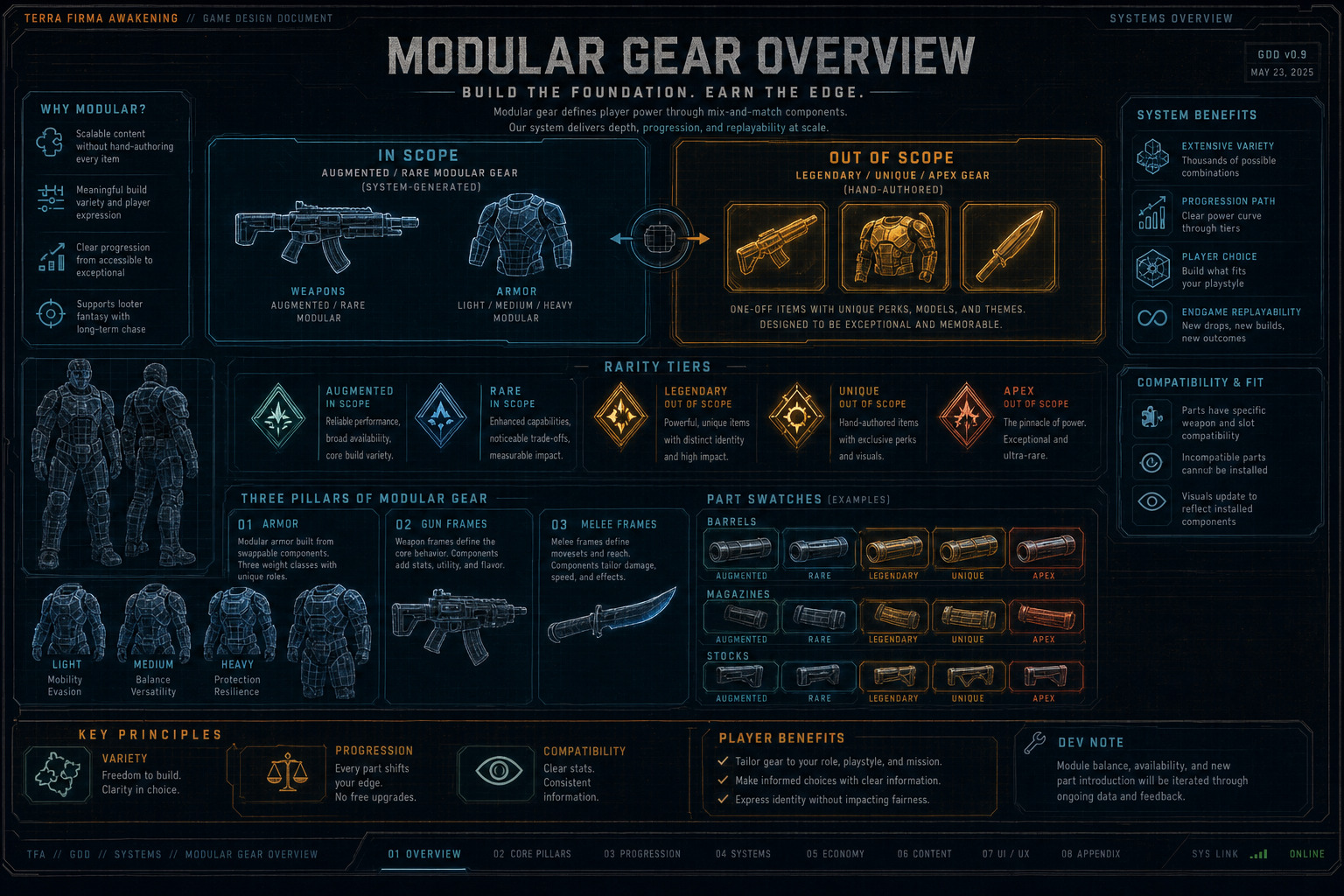
Scope
- Applies to Augmented and Rare weapons (modular parts) and armor (families only).
- Legendary / Unique / Apex = separate tier (fixed art + fixed packages; not modular kits).
- Five corporations share the same weapon families, frames, part sockets, and armor families.
- Corp identity = materials, decals, and telemetry inside the same volumes — not different socket layouts.
- Each modular part socket ships five corp visual variations (same AABB / volume). See vol. 09.
- Gunfeel part dials (locked): Recoil, Impact, Stability, Barrel Jump, Barrel Sway, Reload Speed, Airborne Effectiveness, Hip-Fire Effectiveness, Slide-Fire Effectiveness, Magazine Size, Equip Speed, Kickback.
- Not part-owned: Rotation, Strafing, Bullet Magnetism, Stickiness (frame Aim Assist baseline).
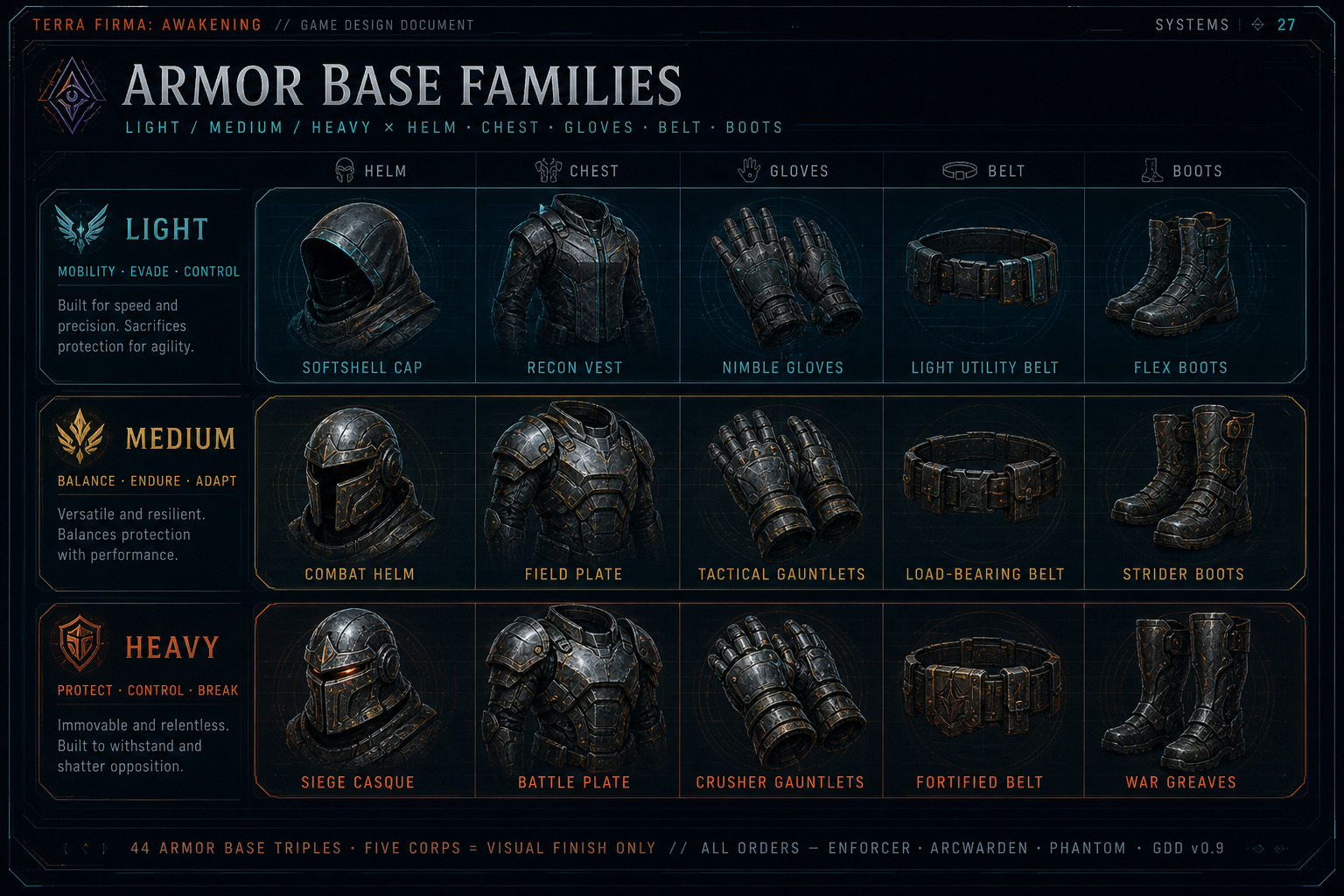
Weapon Frame Contract (3D)
- Each weapon family uses a fixed frame mesh (chassis) with fixed socket transforms.
- Every modular part must fit the same volume and location on that frame (max mesh bounds per socket). Different look, same footprint.
- Sockets also lock VFX attach points (muzzle flash, mag eject, ADS optic offset).
- Animation skeleton (reload / inspect / ADS / melee swing) stays on the frame — parts do not retime core anims.
- Modules change frame base stats within Receiver bands (see Part → Stat Roles below).
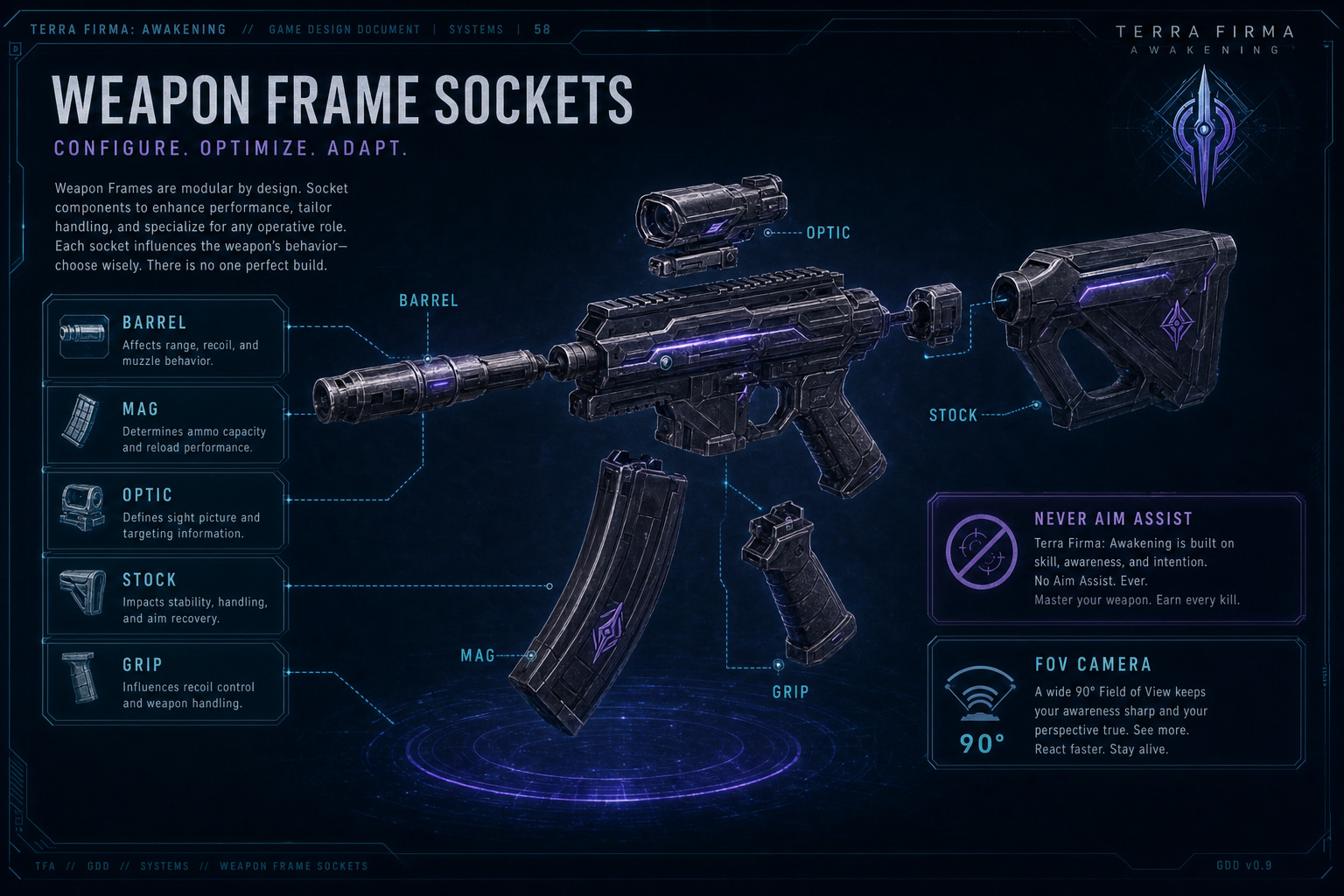
Armor Families (No Modules)
- Armor families: Light, Medium, Heavy — shared across all five corporations.
- No modular armor parts. Family silhouette / look is the base; Affixes (Prefix/Suffix) provide the variable stats.
- Light biases mobility; Medium balanced; Heavy biases defense / DR.
- Former module roles (Plating, Underlayer, Sealant, Power Cell, Sensor Pack, Servo Bundle, Trauma Weave) live in the Augmented Prefix / Suffix lists (vol. 04).
Exact Variables Changed by Each Part
Section titled “Exact Variables Changed by Each Part”Each modular part owns specific weapon variables on the shared frame. Corp visual variants (C1–C5) change look only — they do not change which variables the socket owns.
LOCKED gunfeel dials from Aim Assist / Gunfeel Programming that parts may change: Recoil, Impact, Stability, Barrel Jump, Barrel Sway, Reload Speed, Airborne Effectiveness, Hip-Fire Effectiveness, Slide-Fire Effectiveness, Magazine Size, Equip Speed, Kickback. Rotation / Strafing / Bullet Magnetism / Stickiness stay frame baseline only. Parts never rewrite FOV or camera baseline.
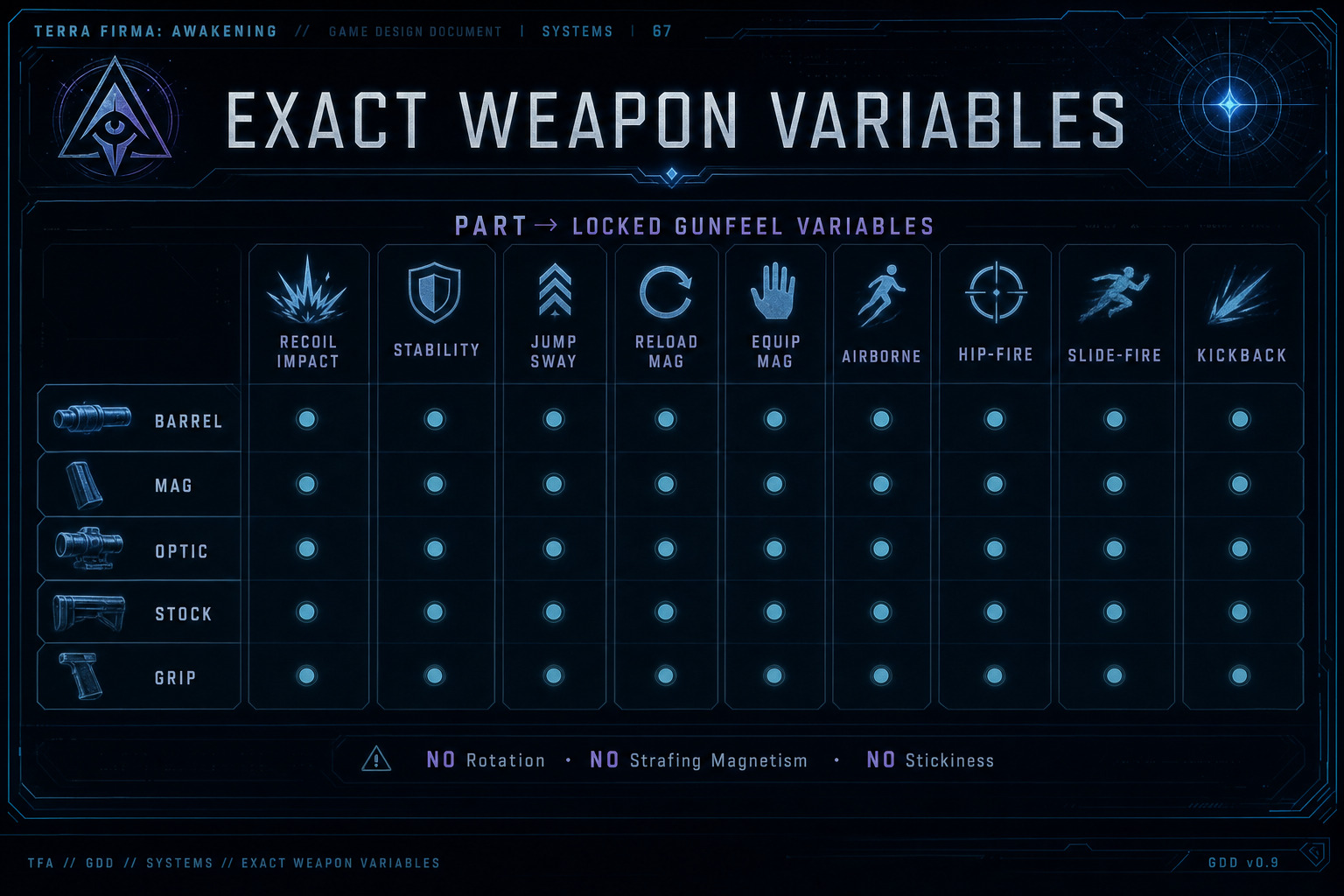
Gunfeel Ownership (Shared Sockets)
- Barrel → Recoil, Impact, Barrel Jump
- Magazine → Magazine Size, Reload Speed
- Optic → Hip-Fire Effectiveness
- Stock → Stability, Barrel Sway, Kickback
- Grip → Equip Speed, Airborne Effectiveness, Slide-Fire Effectiveness (also supports Reload Speed / Hip-Fire)
Gun Parts → Weapon Variables
- Barrel
- Primary variables: Recoil; Impact; Barrel Jump
- Secondary variables: Range; Accuracy Falloff; Projectile / Pellet Velocity; Pellet Spread (Shotgun)
- Note: Gunfeel: Recoil / Impact / Barrel Jump. Secondary ballistic: Range / falloff / velocity.
- Magazine / Cylinder / Tube / Drum / Box Magazine
- Primary variables: Magazine Size; Reload Speed
- Secondary variables: Reserve Ammo
- Note: Gunfeel: Magazine Size / Reload Speed.
- Optic / Sight
- Primary variables: Hip-Fire Effectiveness
- Secondary variables: ADS Acquisition; Zoom Band; ADS Initial Accuracy
- Note: Gunfeel: Hip-Fire Effectiveness. Secondary: sighting / ADS tooling (not assist baseline).
- Stock / Shoulder Brace / Brace
- Primary variables: Stability; Barrel Sway; Kickback
- Secondary variables: Equip Speed; Recoil (support)
- Note: Gunfeel: Stability / Barrel Sway / Kickback (return-to-ready settling). Kickback ≠ Rotation assist.
- Grip / Bipod-Grip / Grip-Brace
- Primary variables: Equip Speed; Airborne Effectiveness; Slide-Fire Effectiveness
- Secondary variables: Reload Speed; Hip-Fire Effectiveness; Stability (minor)
- Note: Gunfeel: Equip Speed / Airborne / Slide-Fire. Supports Reload + Hip-Fire.
- Bipod (MG / Heavy / Sniper)
- Primary variables: Stability (braced); Barrel Jump (braced); Barrel Sway (braced)
- Secondary variables: Kickback (braced); Equip Speed (undeployed)
- Note: Braced-fire gunfeel spike (Stability / Jump / Sway / Kickback).
- Accelerator Coil / Rail (Fusion / Linear)
- Primary variables: Range; Bolt / Beam Velocity; Stability (during charge)
- Secondary variables: Impact; Handling
- Note: Charge ms stays on the Frame (FS-GUN-007). Coil never writes cadence.
- Emitter Lens (Trace)
- Primary variables: Beam Focus (Accuracy); Range; Tick Rate Feel
- Secondary variables: Stability; Heat / Sustained Fire Window
- Note: Trace focus / sustain; Stability is the gunfeel hook.
- Cell (Fusion / Linear / Trace / Glaive energy)
- Primary variables: Magazine Size; Reload Speed
- Secondary variables: Energy Efficiency; Reload Speed (vent)
- Note: Gunfeel: Magazine Size / Reload Speed (energy mag analogue).
- Tube (Rocket)
- Primary variables: Projectile Velocity; Range; Blast Travel Time
- Secondary variables: Reload Speed; Equip Speed
- Note: Rocket flight dials; Reload / Equip are the gunfeel hooks.
- Warhead Rack (Rocket)
- Primary variables: Impact; Blast Radius
- Secondary variables: Magazine Size; Reload Speed
- Note: Gunfeel: Impact. Secondary: rocket mag / reload.
- Limbs (Bow) / Prod/Limbs (Crossbow)
- Primary variables: Impact; Range
- Secondary variables: Hold Stability (full draw); Handling
- Note: Bow power; Impact / Stability are the gunfeel hooks.
- String (Bow / Crossbow)
- Primary variables: Hold Stability; Handling
- Secondary variables: Equip Speed; Hip-Fire Effectiveness
- Note: Draw ms stays on the Frame (FS-GUN-007). String never writes cadence.
- Quiver (Bow) / Magazine/Quiver (Crossbow)
- Primary variables: Magazine Size; Reload Speed
- Secondary variables: Equip Speed
- Note: Gunfeel: Magazine Size / Reload Speed (nock / carried count).
Melee Parts → Weapon Variables
- Blade / Bit / Head / Tip / Talons / Cap
- Primary variables: Base Damage (min–max); Attack Rating
- Secondary variables: Weapon Speed; Reach
- Note: Primary damage / AR dial.
- Guard / Collar / Knuckle Plate
- Primary variables: Block Chance / Block Rate; Defense while swinging
- Secondary variables: Attack Rating (minor); Hit Recovery
- Note: Defensive / control dial.
- Grip / Haft / Shaft / Grip Wrap / Brace
- Primary variables: Weapon Speed Modifier (WSM / IAS); Handling / Swing Recovery
- Secondary variables: Attack Rating (minor); Equip Speed
- Note: Primary speed / recovery dial.
- Pommel / Butt Spike / Counterweight / Butt Cap / Balance Weight
- Primary variables: Damage↔Speed Balance; Knockback Chance
- Secondary variables: Stun / Crushing Blow bias; Handling
- Note: Weight distribution dial.
- Core / Cell / Servo
- Primary variables: Channel Bias on Hit; Energy on Hit/Kill; Proc Chance
- Secondary variables: Durability / Ethereal-analogue bias
- Note: ARPG identity dial within frame bands.
- Stock / Brace (Glaive)
- Primary variables: Tip Alignment / Swing Settle; Swing Recovery
- Secondary variables: Handling; Melee Swing Recovery
- Note: Glaive Brace is melee-only Weight dial (no projectile).
Numeric bands per part tier ship as data sheets. This table locks variable ownership so art, UI tooltips, and loot tools stay consistent.
Gun Receiver Parts
Section titled “Gun Receiver Parts”Taxonomy: Corp finish → Class → Receiver (Type) → Frame. Receiver is the required structural part that authors Type; Class gates Receivers — different Classes never share Receivers (Hand Cannon ≠ Sidearm, Heavy Gun ≠ Machine Gun, Rocket ≠ Grenade Launcher, Bow ≠ Crossbow; Rifle includes Auto/Pulse/Scout/SMG/Sniper). Most firearms share accessory sockets Barrel / Magazine / Optic / Stock / Grip. Receiver rows list the exact socket set — specialty kits replace the Auto five where listed (Rocket, Bow, Crossbow, Fusion/Linear/Trace, HC/Sidearm, Heavy). Alias sockets (Cylinder/Magazine, Sight, Shoulder Brace, Prod/Limbs, etc.) own the same variables as their parent socket in the table above. Year-1 Refit Install does not swap Receiver. Parts never rewrite Fire Mode, cadence, or AA. Barrel is Class × Receiver–gated; Fusion/Linear/Trace/Rocket/Bow/Crossbow replace Barrel with Accel Coil / Accel Rail / Emitter / Tube / Limbs / Prod/Limbs.
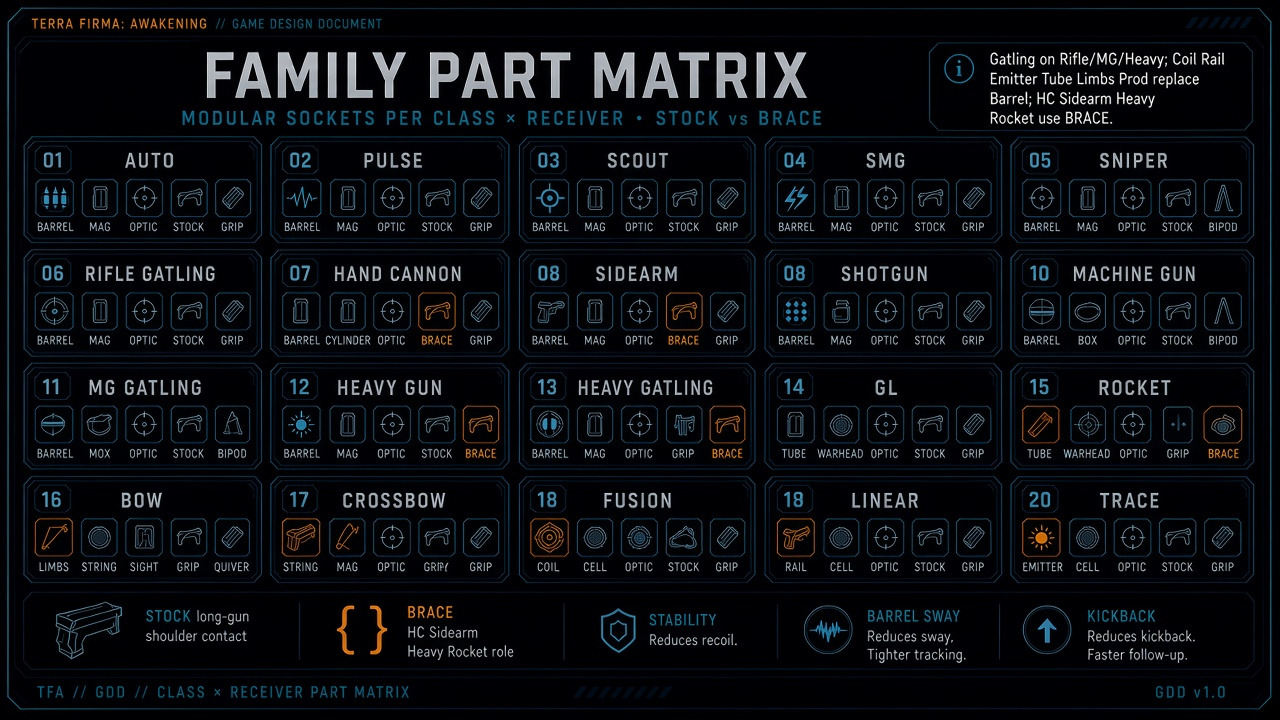
Figure O14. Class × Receiver part matrix — specialty kits for Rocket / Bow / Crossbow / Fusion line; GL keeps Drum five-pack
- Auto: Barrel, Magazine, Optic, Stock, Grip
- Pulse: Barrel, Magazine, Optic, Stock, Grip
- Scout: Barrel, Magazine, Optic, Stock, Grip
- Hand Cannon: Barrel, Cylinder/Magazine, Optic, Grip
- SMG: Barrel, Magazine, Optic, Stock, Grip
- Sidearm: Barrel, Magazine, Optic, Grip
- Shotgun: Barrel, Magazine/Tube, Optic, Stock, Grip
- Sniper: Barrel, Magazine, Optic, Stock, Bipod/Grip
- Fusion: Accelerator Coil, Cell, Optic, Stock, Grip
- Linear Fusion: Accelerator Rail, Cell, Optic, Stock, Grip (owns Grip vars)
- Trace: Emitter Lens, Cell, Optic, Stock, Grip
- Grenade Launcher: Barrel, Drum/Magazine, Optic, Stock, Grip
- Rocket: Tube, Warhead Rack, Optic, Grip/Brace
- Machine Gun: Barrel, Box Magazine, Optic, Stock, Bipod
- Bow: Limbs, String, Sight (owns Optic vars), Grip, Quiver
- Crossbow: Prod/Limbs, String, Sight (owns Optic vars), Grip, Magazine/Quiver
- Heavy Gun (2-Handed): Barrel, Magazine, Optic, Shoulder Brace (owns Stock vars), Bipod/Grip
Melee Modules — V1–V5 Stubs (Effects TBA)
Section titled “Melee Modules — V1–V5 Stubs (Effects TBA)”Each melee Refit socket ships five named lean-mesh variants (V1–V5). Parent socket → frame owner (O17) + Primary/Secondary MeleeFeel is locked — same rule as gun modules: parts change weapon feel, not loot modifiers. Per-variant effect packages are TBA. Corp finishes C1–C5 are paint on the same AABB — they are not the V1–V5 dials.
Exact variables:
docs/superpowers/specs/2026-11-08-melee-part-exact-variables-design.md· art handoff:docs/superpowers/plans/2026-11-08-melee-parts-art-handoff.md· data:_melee_module_variants.py. Parallel to gunfig-140-3/ Exact Weapon Variables.
- Head (Blade / Bit / Tip / Talons / Cap / Double Edge): Frame Damage·AR · Primary Strike Impact / Active-frame timing / Sweet-spot bias — V1–V5 effects TBA
- Guard (Guard / Collar / Knuckle Plate): Frame Block · Primary Clash settle / Defense-while-swinging feel / Swing Stability under trade — V1–V5 effects TBA
- Haft (Grip / Haft / Shaft / Hand Brace / Grip Wrap): Frame WSM · Primary WSM-cadence / Inertia Drop / Handling turn-in — V1–V5 effects TBA
- Pommel (Pommel / Butt Spike / Counterweight / Butt Cap / Brace): Frame Balance · Primary Balance / Recovery Kick / Momentum carry — V1–V5 effects TBA
- Core (Cell / Servo): Frame Channel · Primary Channel spool-up / regen cadence / Special-ready timing — V1–V5 effects TBA
Out of modules: crit, execute, cleave-as-loot, chip%, lifesteal, procs, combo scalers, Reach/length. Staves have no Guard socket — clash/defense-while-swinging from Spine/family band only. Block here is a frame dial, not a Melee Drive Block button.
Wrist Razors / Claws use the keyed kit Talons · Knuckle Plate · Hand Brace · Counterweight · Core and equip only in the Wrist Melee slot (hotkey 1).
Melee Family Parts
Section titled “Melee Family Parts”Parts authority: Figure O17 (Head / Guard / Haft / Pommel / Core → frame stats). Figure O15 is family roster art only (same grid as Figure I) — not the socket part map. Family → socket aliases are listed below.
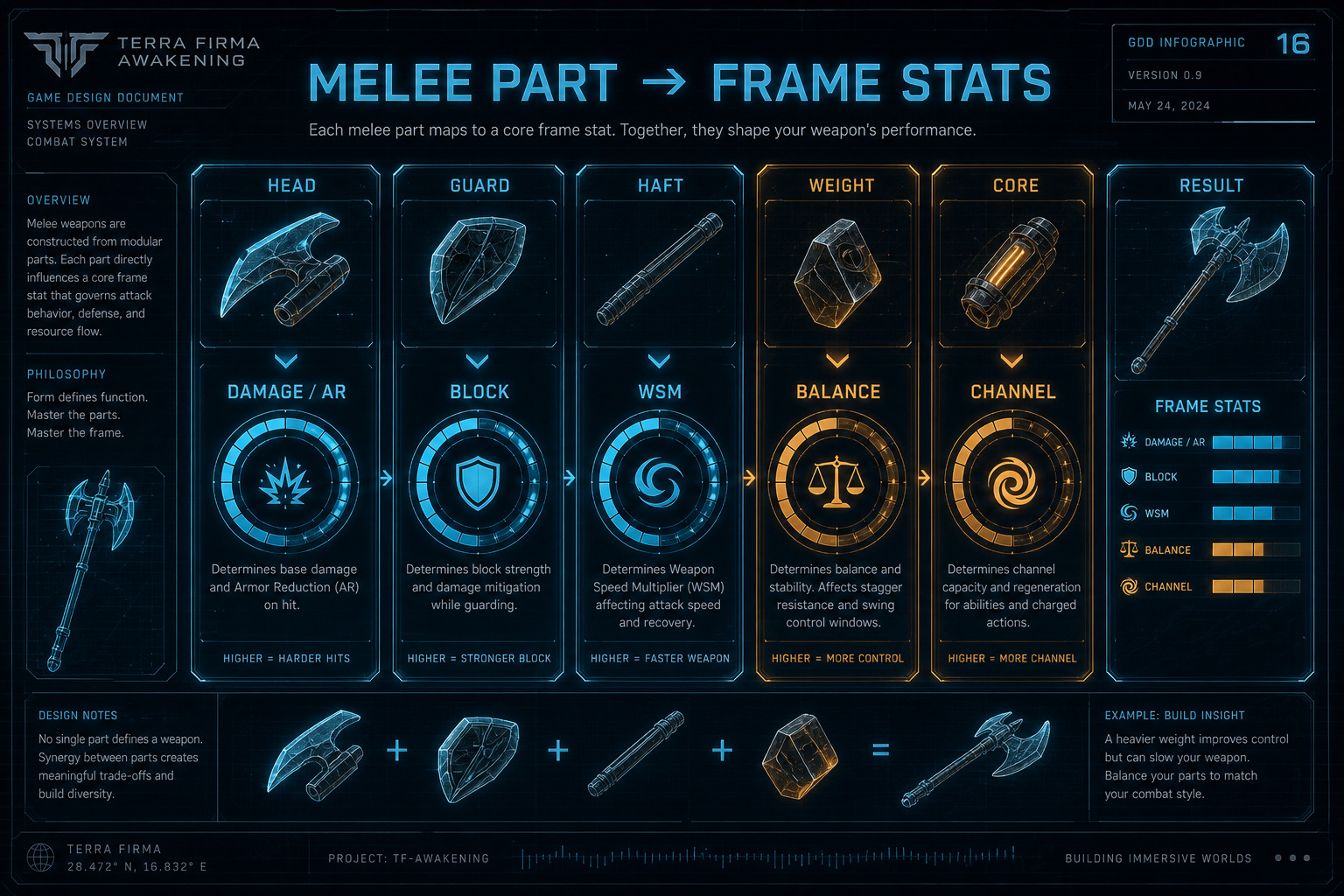
Figure O17. Melee part → frame base stats — exactly five sockets (Head / Guard / Haft / Pommel / Core).
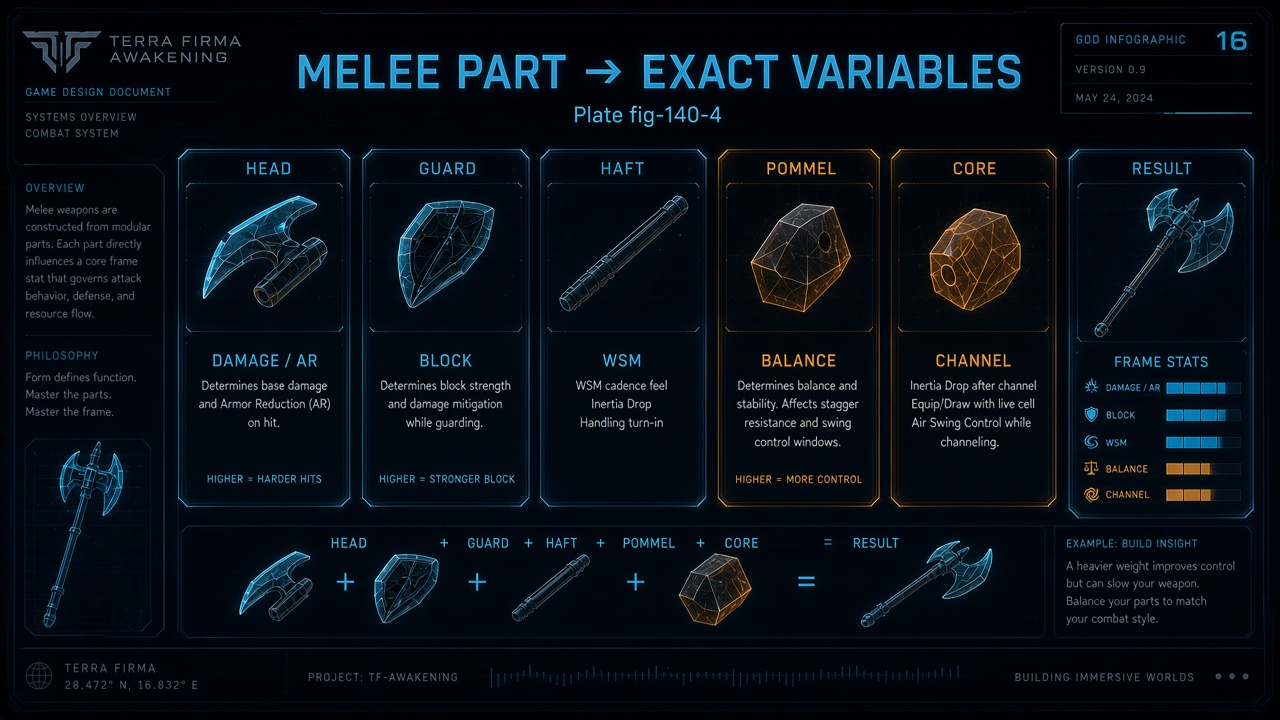
Figure — Melee part → exact variables (Primary / Secondary MeleeFeel). Gun-module rules: feel dials, not affixes. Frame bars remain O17. Spec: 2026-11-08-melee-part-exact-variables-design.md
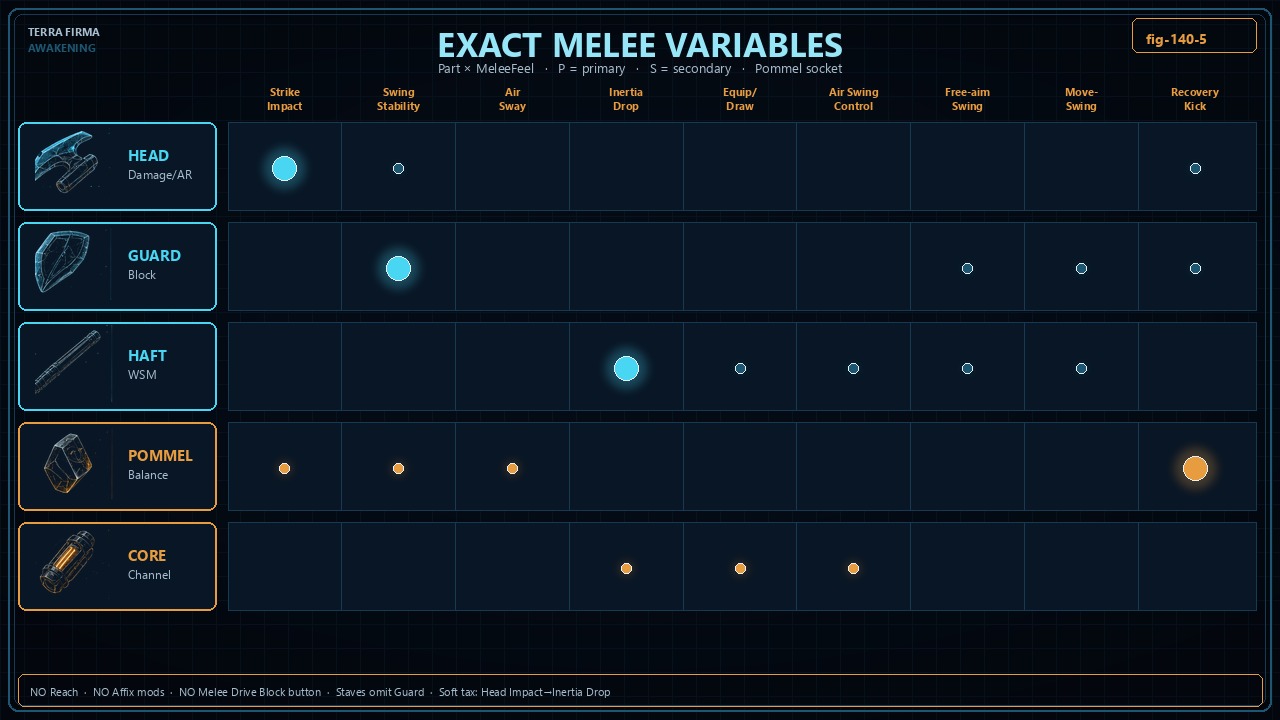
Figure — Exact Melee Variables. Same parts as fig-140-4. P = primary · S = secondary.
Melee frames use Head/Blade · Guard/Collar · Haft/Handle · Weight/Pommel · Core (family variants below). Same volume-lock rule as guns; alias sockets own parent variables from the table above.
- Combat Blades: Blade (owns Head vars), Guard, Grip (owns Haft vars), Pommel, Core
- Cleaving Axes: Bit/Head, Collar (owns Guard vars), Haft, Butt Spike (owns Pommel vars), Core
- Impact Mauls: Head, Collar (owns Guard vars), Haft, Counterweight (owns Pommel vars), Core
- Polearms: Head/Blade, Collar (owns Guard vars), Shaft (owns Haft vars), Butt Cap (owns Pommel vars), Core
- Spears & Lances: Tip (owns Head vars), Collar (owns Guard vars), Shaft (owns Haft vars), Butt Cap (owns Pommel vars), Core
- Dirks & Daggers: Blade (owns Head vars), Guard, Grip (owns Haft vars), Pommel, Core
- Wrist Razors / Claws (Wrist slot only): Talons (owns Head vars), Knuckle Plate (owns Guard vars), Hand Brace (owns Haft vars), Counterweight (owns Pommel vars), Core
- Staves: Cap/Head, Shaft (owns Haft vars), Grip Wrap (owns Haft vars), Butt Cap (owns Pommel vars), Core
- Scepters / Rods: Head, Collar (owns Guard vars), Haft, Pommel, Core
- Heavy Spears: Tip (owns Head vars), Collar (owns Guard vars), Shaft (owns Haft vars), Butt Cap (owns Pommel vars), Core
- Glaives: Tip/Blade (owns Head vars), Collar (owns Guard vars), Shaft (owns Haft vars), Brace (owns Pommel vars), Core
- Dual Blade: Double Edge (owns Head vars), Collar (owns Guard vars), Haft, Pommel, Core
Augmented vs Rare Depth
- Augmented weapons: fewer installed modules / smaller variable deltas (typically 1–2 meaningful parts).
- Rare weapons: more installed modules / larger packages (aligns with multi-affix Rare depth).
- Empty weapon sockets use family baseline stats — combat and gunfeel still function.
- Armor Augmented vs Rare depth is entirely via Prefix/Suffix count and magnitude (same as other armor affixes) — not part sockets.
Exact numeric bands per weapon part tier ship as data sheets. This section locks weapon socket names, part→stat ownership, family coverage, volume-lock art rules, armor family-only contract, and the Augmented/Rare-only scope. Forge / Refit and part unlocks live on the Crafting Page — parts are an unlock catalog (Family × Socket × Variant), not bag tiles. C1–C5 is paint.