Aim Assist & Gunfeel Programming
Precision Fire (FPP) is not raw mouse/stick only. Every firearm is tuned through Range, Accuracy, Bloom, Aim Assist, Recoil, Stability, and handling stats. This gunfeel baseline is not retuned by Phonon sockets or Hybrid Perspective camera verbs — Phonon Chords may still add ARPG item power to the gun (ED, skills, leech, resists, utility) without changing Aim Assist / ADS / FOV.
Source: AIM ASSISTS design notes. Baseline Aim Assist and gunfeel are identical across Story, Progressive Multiplayer, and Competitive Ladder. Affixes, perks, and weapon rolls may modify assist-adjacent stats where gear is allowed — they do not change the shared baseline table.
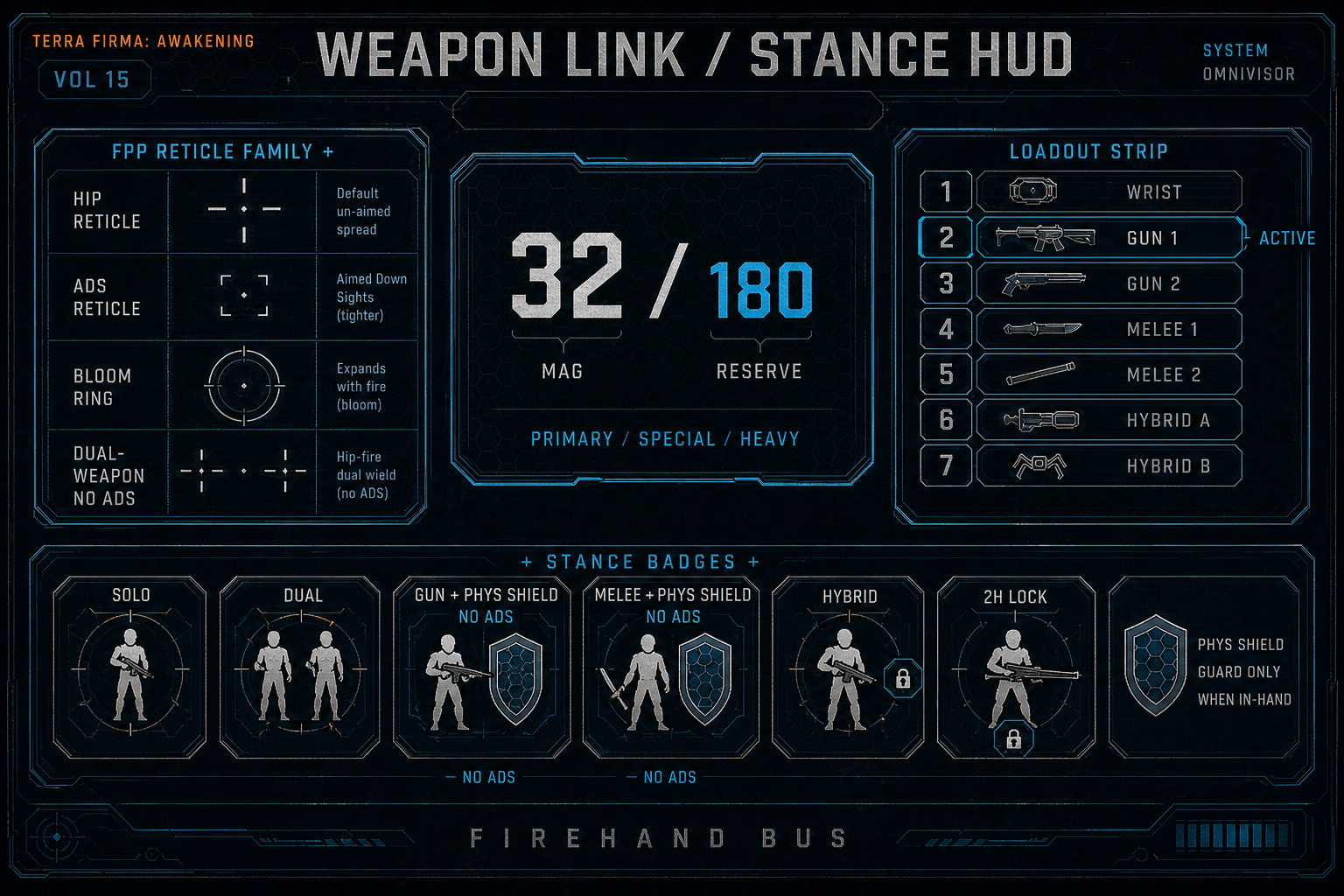
Range Cone
- Defined by a weapon Range value. Inside optimal range the cone is tighter / more precise.
- Past the Range breakpoint, damage falloff applies and accuracy falloff worsens.
- Range is a hard design dial per frame/family and can be modified by barrels/scopes/mods.
Accuracy
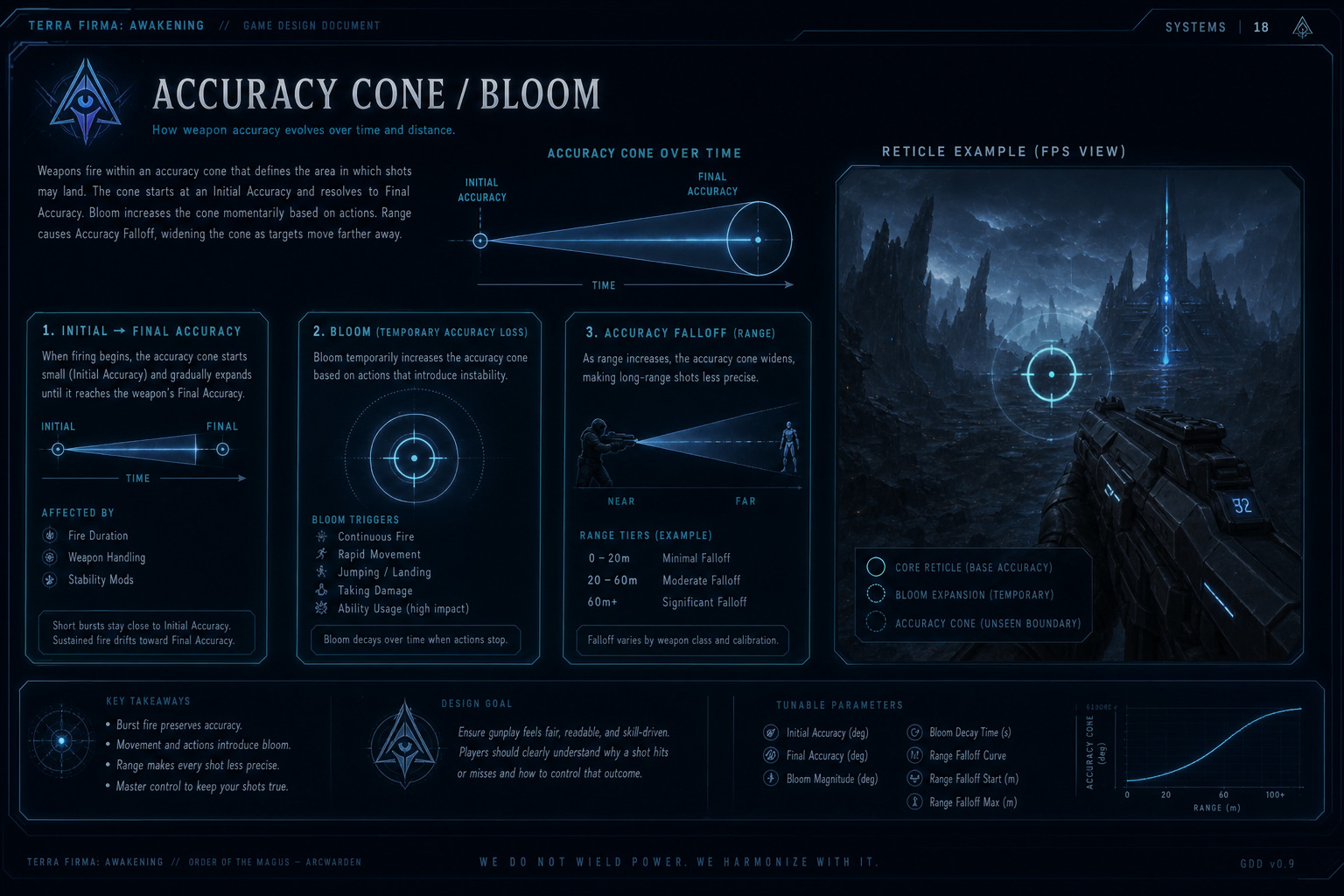
Section titled “Accuracy”Accuracy Cone
- Angular cone that contains every shot. Cone shape/angle differs by weapon frame (Adaptive, Aggressive, Precision, Rapid-Fire, Lightweight, High-Impact).
- All projectiles stay inside the current accuracy cone — no random shots outside it.
Initial Accuracy
- Starting cone when the trigger is first pressed. Baseline: fairly accurate for all weapons.
- Lower-tier / poorly rolled weapons may ship with worse Initial Accuracy.
Final Accuracy
- End-state of the cone after sustained fire — total deviation of the firing pattern.
- As the player holds the trigger, the pattern walks from Initial → Final Accuracy.
Accuracy Falloff
- Rate and magnitude of cone growth depend on weapon, mods, and fire rate (Rapid-Fire frames degrade faster).
- Tied to Range: outside the Range value, Accuracy Falloff is greater.
Bloom
- Reticle scales larger as the player fires, communicating lost accuracy.
- Bloom is the player-facing expression of the accuracy cone getting larger.
Aim Assist
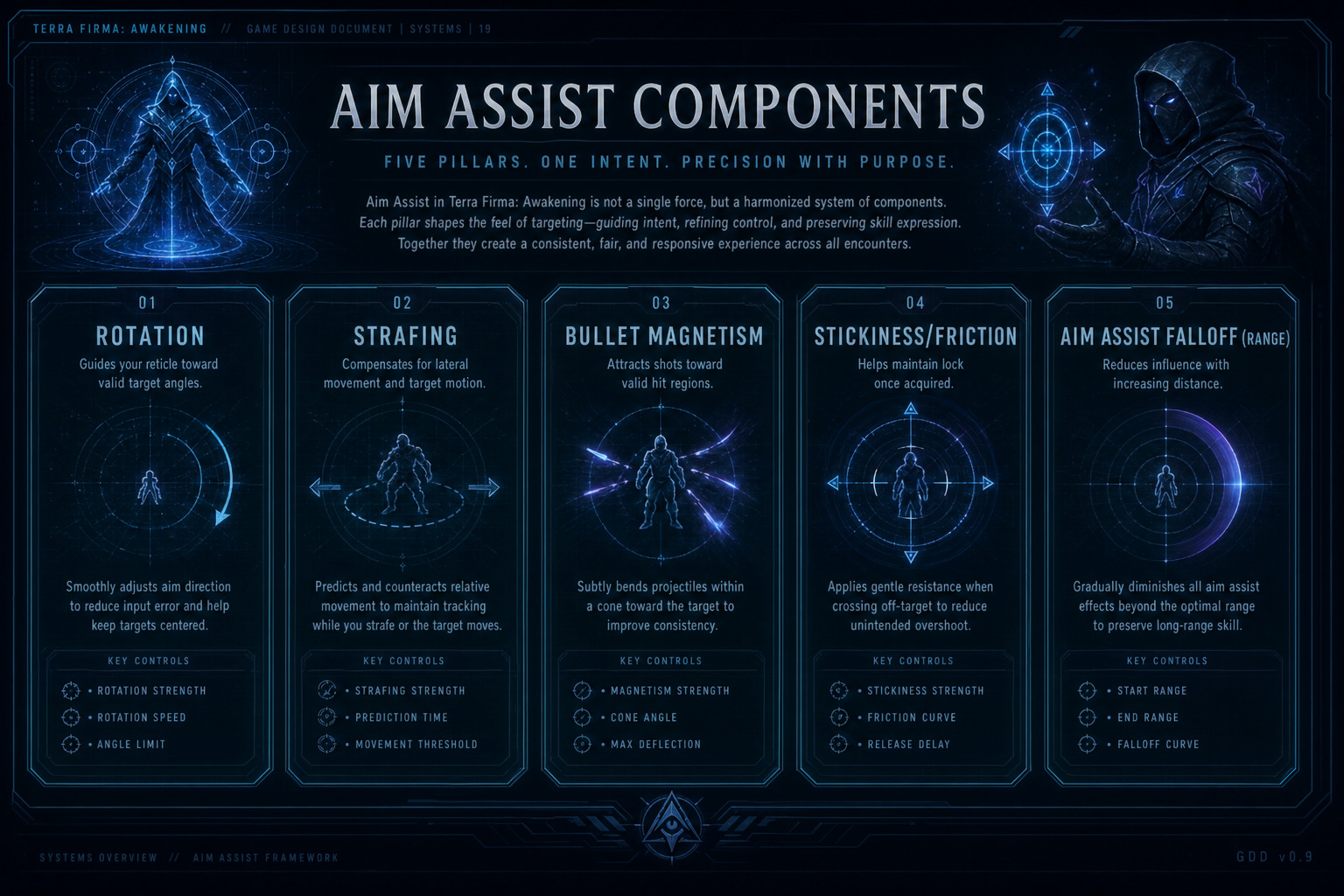
Section titled “Aim Assist”Aim Assist is a composite of rotation help, strafing help, bullet magnetism, and reticle stickiness/friction. Strength falls off with Range.
Components
- Rotation — assist that helps the camera/reticle rotate onto a target.
- Strafing — assist that tracks a laterally moving target while the player strafes.
- Bullet Magnetism — how far a shot may deflect from the barrel toward a valid target.
- Stickiness / Friction — how strongly the reticle wants to stay on a target it is already on (reticle slowdown near target + sticky follow).
- Aim Assist Falloff (Range) — assist strength decays as distance approaches / exceeds Range.
What Aim Assist Affects
- Reticle slowdown — stick/mouse speed decreases when near a valid target.
- Reticle stickiness — how much the reticle wants to stick with a target it is already on.
- Bullet magnetism — how far the shot deflects from the barrel toward a target.
Aim Assist Degradation
- While firing, the effective diameter around the reticle where bullet magnetism works degrades (shrinks / weakens).
- Higher Stability slows that degradation. Low Stability burns magnetism radius faster.
Recoil
Section titled “Recoil”- Recoil — kick magnitude / pattern strength while firing. Higher Recoil fights the player harder during the burst.
- Kickback — how long / how far the weapon takes to return to a ready firing position after the shot or burst (settling). Tuned separately from Recoil.
- Recoil Patterns — per-frame / per-family kick paths (vertical bias, zig-zag, etc.). Patterns are authored assets, not pure random.
Recoil pattern tables are TBD per family; patterns must be readable and learnable. Parts may change Recoil and Kickback; patterns stay frame-authored.
Impact, Stability, Barrel Jump & Sway
Section titled “Impact, Stability, Barrel Jump & Sway”Impact
- Amount of damage (per-shot / per-pellet impact value before channel resists and crit).
- Shotgun Shot Type (FS-GUN-010):
Spread= multi-pellet cone (Impact splits across pellets).Single= one projectile like Rifle / Hand Cannon / Sidearm (full Impact on one hit; Pellet Spread N/A).
Stability
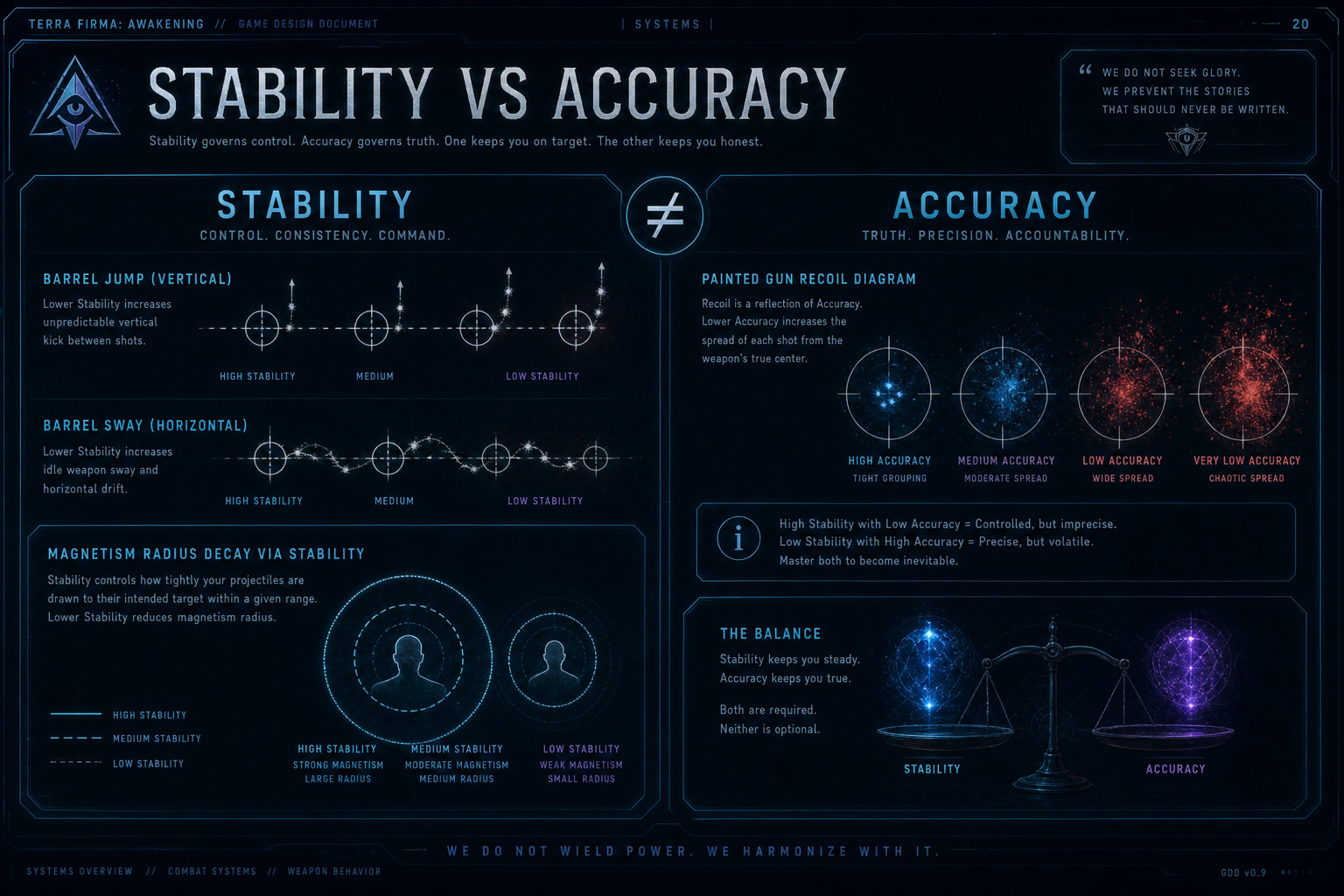
- Lower Stability increases randomness inside the deviation envelope set by Final Accuracy.
- Stability affects barrel and reticle movement while firing.
- Stability also governs how fast the bullet-magnetism diameter around the reticle degrades. Higher Stability = slower degradation.
- Stability does not necessarily fully reset between shots — the gun can come to rest in a different aim position if the player does not correct.
Barrel Jump (Vertical)
- Tied to Recoil: how much the barrel and aim move with each shot. Higher Barrel Jump = more vertical climb.
- Increasing Stability decreases the physical distance the barrel/aim moves per shot.
Barrel Sway (Horizontal)
- Same idea as Barrel Jump, but for horizontal movement of barrel/aim.
Stability vs Accuracy (Separate Mechanics)
Stability and Accuracy work together but are not the same stat. A gun with high Accuracy but low Stability is still inaccurate: even if bullets leave the barrel straight, the barrel itself moves radically after each shot and spreads the pattern. A gun with high Stability but low Accuracy is also inaccurate: the barrel stays calm, but a high error angle still spreads bullets from the muzzle. Designers must tune both.
Handling & Situational Effectiveness
Section titled “Handling & Situational Effectiveness”- Reload Speed — time to refill the magazine.
- Magazine Size — rounds before reload.
- Equip Speed — time to bring the weapon up after swap / stow.
- Airborne Effectiveness — accuracy / assist / bloom modifiers while in air.
- Hip-Fire Effectiveness — cone, bloom, and assist when not ADS.
- Slide-Fire Effectiveness — cone, bloom, and assist while sliding.
Critical Hits (Gunfire)
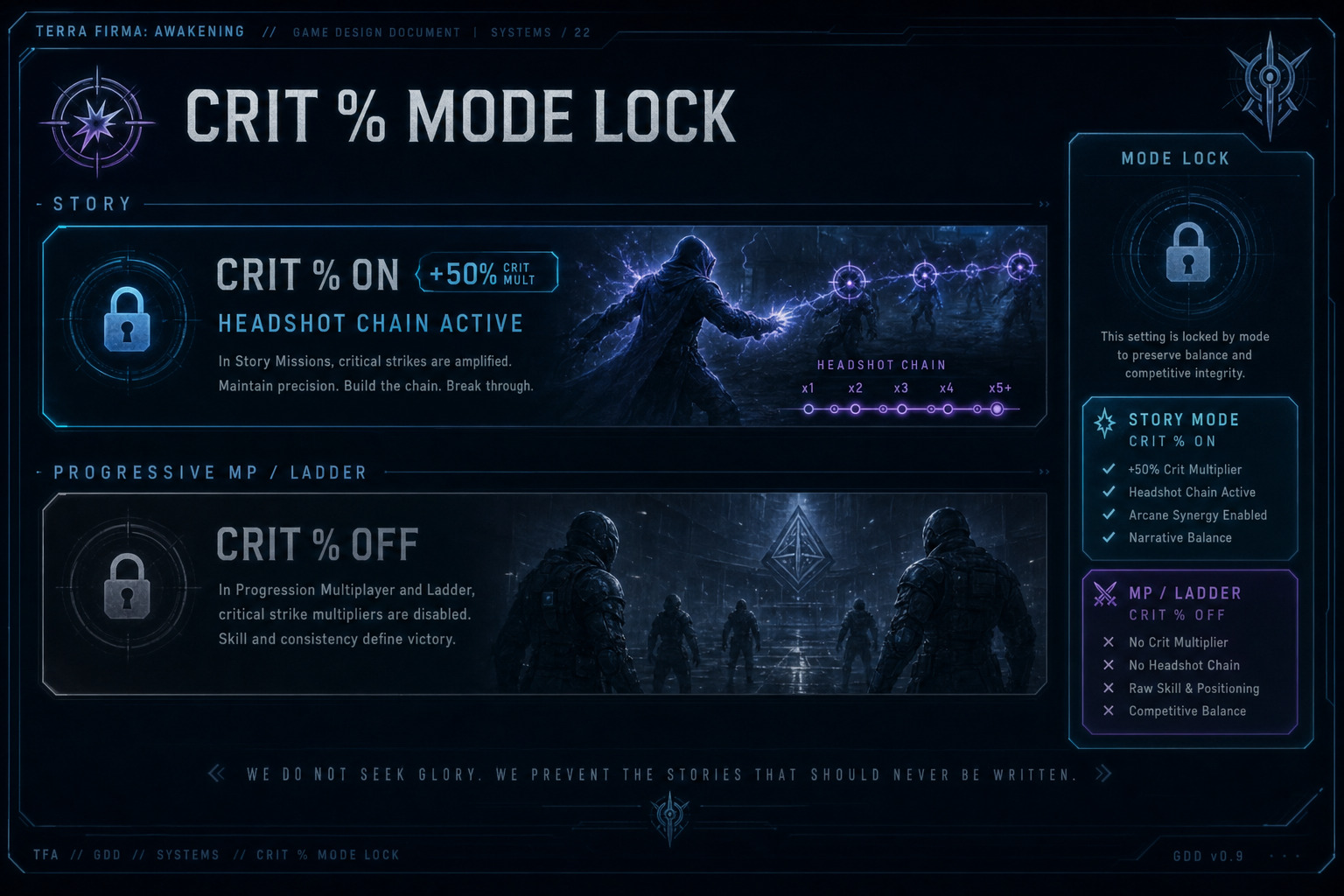
Section titled “Critical Hits (Gunfire)”- MODE LOCK — Progressive Multiplayer and Competitive Ladder: Crit % is disabled (no Crit % rolls, no Crit % from gear/skills/affixes).
- Story / offline: Crit % outside of headshot — chance for a non-headshot to roll as a critical.
- Where Crit % exists (Story): Crit shots increase damage by +50% (baseline crit multiplier).
- Crit+ % — on multiple consecutive headshots, damage doubles (headshot chain bonus). Still applies only where Crit systems are enabled (Story); Progressive / Ladder do not use Crit %.
- Crit Damage — additive/multiplicative crit damage scaling from gear/perks (Story only; Progressive / Ladder ignore Crit Damage tied to Crit %).
- Body Shot Damage — baseline non-crit torso damage before resists.
Headshot TTK rules from the Hybrid Perspective engine still apply in all modes. Progressive Multiplayer and Competitive Ladder resolve shooting damage without Crit % — aim, headshots, frame damage, and mode rulesets only.
Unified Baseline Across All Modes
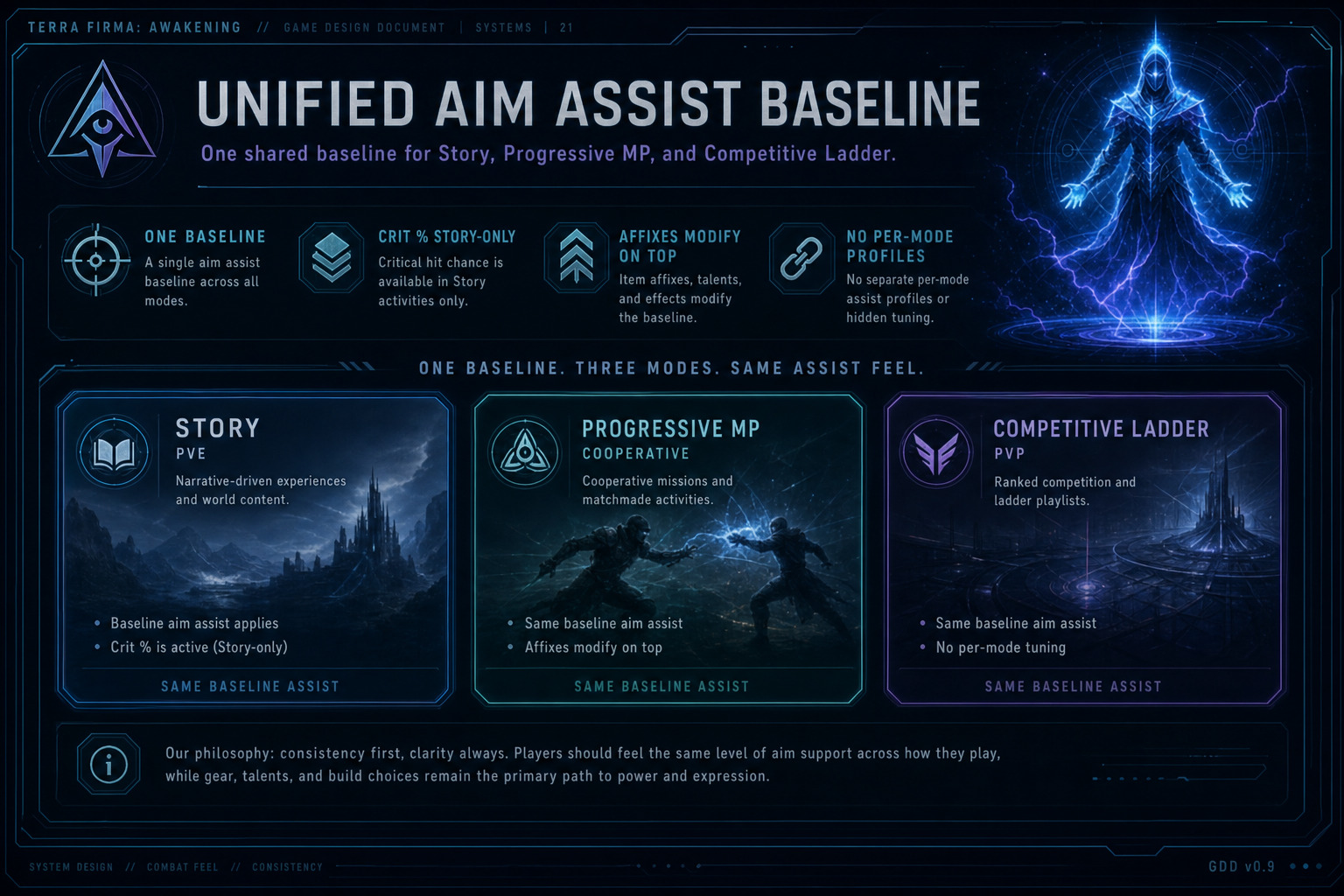
Section titled “Unified Baseline Across All Modes”There is one standard Aim Assist / gunfeel table for the game. Story co-op, Progressive Multiplayer, and Competitive Ladder all use the same baseline values for Range, Accuracy, Bloom, Aim Assist (Rotation, Strafing, Magnetism, Stickiness), Recoil, Stability, Barrel Jump/Sway, and handling.
- Do not author separate Ladder / Progressive / Story aim-assist profiles.
- Mode differences come from rulesets elsewhere (loot, AR/Def on ballistics, gear normalization, Crit % availability) — not from a different assist feel.
- Crit % is Story-only. Progressive Multiplayer and Competitive Ladder have no Crit %.
- Competitive Ladder still uses the same baseline assist; normalized kits simply strip or flatten affix modifiers so everyone feels the shared standard.
Gun Parts — Locked Gunfeel Dials Only
Augmented/Rare modular gun parts may change ONLY this locked gunfeel set (family-band deltas on the shared frame). They do not own Rotation / Strafing / Bullet Magnetism / Stickiness, and they never rewrite FOV or camera baseline.
- Recoil — Barrel (primary); Stock may support.
- Impact — Barrel (primary); Warhead / Limbs on specialty frames.
- Stability — Stock (primary); Grip / Bipod support.
- Barrel Jump — Barrel (primary); Bipod braced variants.
- Barrel Sway — Stock (primary); Bipod braced variants.
- Kickback — Stock (primary; return-to-ready settling). Distinct from Rotation assist.
- Reload Speed — Magazine (primary); Grip / Cell / Quiver support.
- Magazine Size — Magazine (primary); Cell / Quiver / Warhead on specialty frames.
- Equip Speed — Grip (primary); Stock / Tube support.
- Hip-Fire Effectiveness — Optic (primary); Grip support.
- Airborne Effectiveness — Grip (primary).
- Slide-Fire Effectiveness — Grip (primary).
- NOT part-owned (frame Aim Assist baseline only): Rotation, Strafing, Bullet Magnetism, Stickiness / Friction.
- Prefixes/suffixes and perks may still push Bloom, Range, and assist-adjacent affix hooks where gear is allowed — separate from the locked part dials above.
- Progressive / Story: full affix + part influence where items allow.
- Ladder: same baseline; affix influence removed or capped by gear normalization.
Engineering acceptance: one global baseline table per weapon frame. Expose Rotation, Strafing, Magnetism, Stickiness, Range Falloff, Bloom, Barrel Jump, Barrel Sway, and Stability→magnetism degradation as independently tunable frame dials — not per mode. Modular parts only delta the locked gunfeel set (Recoil, Impact, Stability, Barrel Jump, Barrel Sway, Reload Speed, Airborne / Hip-Fire / Slide-Fire Effectiveness, Magazine Size, Equip Speed, Kickback). Affix hooks may add further deltas; Ladder zeroes affix deltas.